EnergyTrackr: A Modular Energy Regressions Detection Tool
October 12, 2026·,,, ·
0 min read
·
0 min read
François Bechet
Jérôme Maquoi
Luís Cruz
Benoît Vanderose
Xavier Devroey
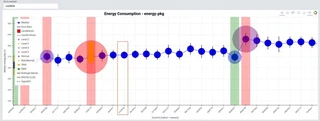 Evolution plot showing the commit cc2363e and nearby commits from JSoup. Each blue dot is the median energy consumption, with corresponding black error bars. The red (resp. green) vertical bars represent commits with a level of at least 2 with an energy regression (resp. improvement). Commits with an additional colored circle denote regressions with their certainty level: blue for level 2, orange for level 3, purple for level 4, and red for level 5. The levels can be cumulated and are all visually represented.
Abstract
Energy efficiency is increasingly recognized as an important dimension of software quality. As systems evolve rapidly, tracking how energy consumption changes across versions can provide valuable insights for developers and researchers. Although detecting energy regressions (i.e., unintended increases in energy consumption) remains challenging due to measurement variability and complex execution environments, recent advances now make systematic analysis practical. Still, dedicated support for monitoring energy behavior over a project’s history is missing. This paper presents EnergyTrackr, a modular, open-source tool for automatically detecting, classifying, and visualizing energy regressions across a commit history. EnergyTrackr traverses a specified set of commits, builds each revision, and measures application-level energy consumption by executing the test suite using the RAPL-based Linux perf utility. It applies established best practices for measurements such as warm-up, randomized execution, repetition, and thermal control. The resulting data are analyzed through a statistical pipeline that filters outliers and classifies energy changes using multiple criteria (e.g., significance, practical impact, …). EnergyTrackr generates interactive reports that provide a comprehensive view of energy evolution and is designed for easy integration into existing Linux workflows. A preliminary evaluation on large Java projects shows that EnergyTrackr can produce stable measurements at scale and effectively identify energy regressions.
Type
Publication
Proceedings of the 41st IEEE/ACM International Conference on Automated Software Engineering (ASE ‘26)

Authors
Xavier Devroey
(he/him)
Professor of Software Engineering and Testing
My name is Xavier Devroey. I am an assistant professor of software engineering at the University of Namur, Belgium 🇧🇪, where, together with Benoît Vanderose, we co-lead the SNAIL Team. 🐌 My research goal is to ease software testing by exploring new paths to achieve a high level of automation for test case design, generation, selection, and prioritization.